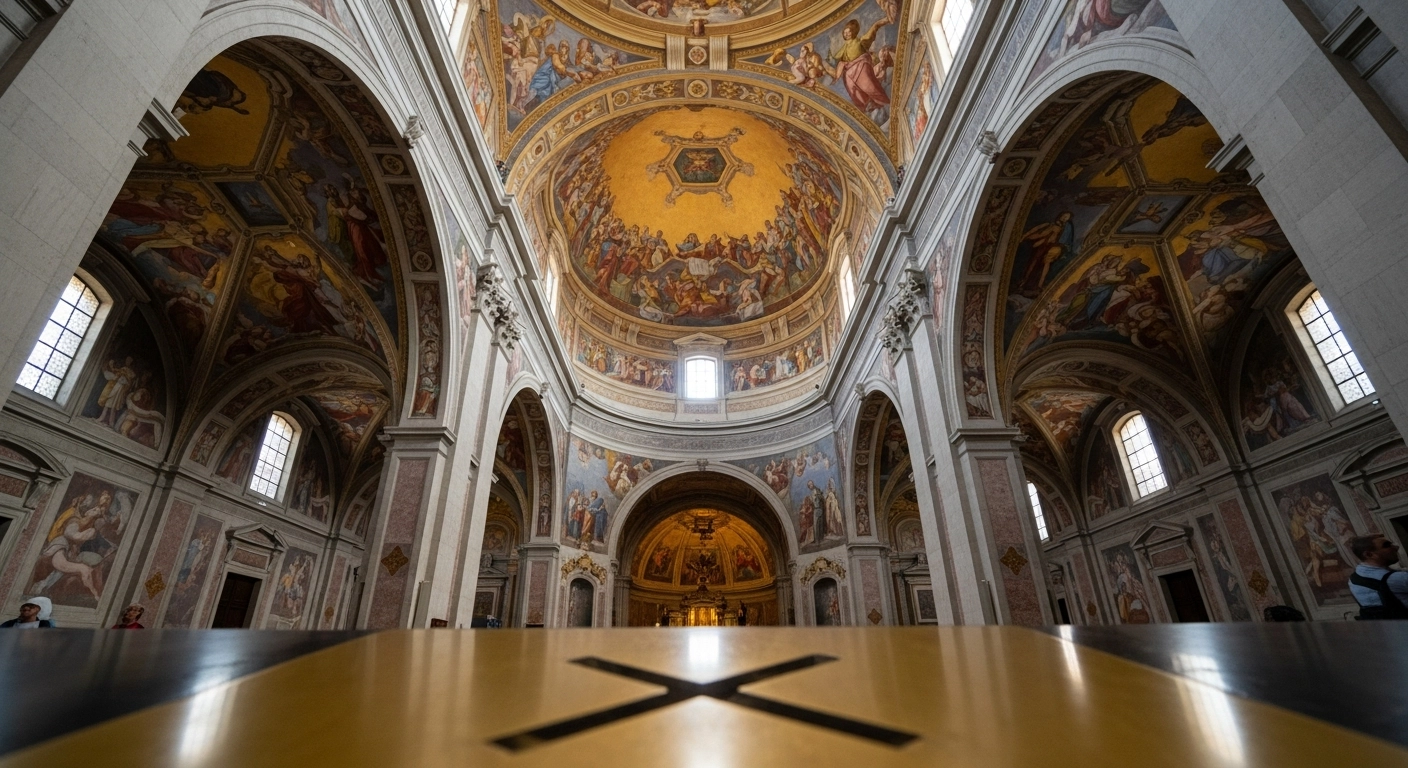
They ran out of budget for a real dome so they hired a painter to fake it with 3D perspective. Stand on the gold marker and it is a masterpiece; take one step left and the whole ceiling turns into a flat distorted mess. This isn’t some abstract art installation; this is the ceiling of the Church of Sant'Ignazio di Loyola in Rome, and if you aren’t paying attention, you'll walk right by one of the most audacious, budget-conscious deepfakes in art history. Forget the crowded Colosseum for a moment, because what Andrea Pozzo pulled off here in the late 17th century with a paintbrush and some serious geometrical savvy is a testament to human ingenuity when funds run low.
This architectural sleight of hand is completely free to experience, which immediately sets it apart from Rome's usual €20+ entry fees for major sites. You’ll find it tucked away a few blocks from the Pantheon, often missed by the throngs hustling between more "important" monuments. The trick is to locate the small yellow marble disk embedded in the floor directly beneath the center of the nave. From this precise spot, the painting above you transforms into a perfectly proportioned, soaring dome. Shift your weight just a foot in either direction, and the illusion collapses, revealing a flat canvas with wildly skewed perspectives. It's an instant lesson in the fickle nature of perception and a good reminder that not everything you see, even in a sacred space, is what it seems.
To truly savor Sant'Ignazio and other Roman wonders without your wallet weeping, consider your timing. Visiting between March and June presents a spectrum of experiences. March still offers the crisp, occasionally chilly air of winter’s end, with fewer crowds and generally better prices on flights and accommodation. Pack layers, as daytime temperatures hover between 45-60°F (7-15°C), but evenings can drop significantly. April and May are Rome’s sweet spot: blooming flowers, comfortably warm days ranging from 55-75°F (13-24°C), and longer daylight hours. However, this perfection comes at a cost, as crowds swell, and prices for everything from gelato to hotel rooms begin their upward climb. By June, Rome is heating up, often reaching 70-85°F (21-30°C), and tourist season is in full, sweaty swing, making early morning explorations a strategic necessity. Direct flights from the East Coast U.S. typically clock in around 8-9 hours, while West Coasters are looking at 11-14 hours, so factor in a day or two for jet lag, regardless of the season.
The real budget hack in Rome isn’t about finding one cheap flight; it’s about a mental shift. Instead of fixating on crowded, expensive attractions, embrace the city’s lesser-known treasures, many of which are free or inexpensive. After your mind-bending experience at Sant’Ignazio, take a short walk to the Pantheon. While a popular spot, its entrance remains blessedly free, offering a staggering architectural experience often overshadowed by its more ticketed counterparts. Don't just pop in and out; sit on one of the benches, look up at the oculus, and absorb the history for twenty minutes. It’s an immersion, not just a photo op.
For a truly off-the-beaten-path cultural dive, skip the long lines at the Borghese Gallery and instead take a metro ride to Centrale Montemartini. This former power plant now houses an incredible collection of classical Roman sculptures, displayed among the original industrial machinery. The juxtaposition of ancient art against massive turbines and engines is striking, visually arresting, and provides a unique context often missing from traditional museums. Entry is typically around €7.50, a fraction of other galleries, and you'll find actual locals, not just busloads of tourists. It’s a compelling, alternative view of Roman history that most guidebooks inexplicably overlook.
When your stomach starts rumbling, resist the siren song of restaurants with English menus and glossy photos near major piazzas; these are often overpriced tourist traps. Wander a few blocks off the main drag into the quiet backstreets, especially in neighborhoods like Testaccio or the less-trodden parts of Trastevere. Look for a trattoria packed with Italian families. A good rule of thumb: if the menu is handwritten and only in Italian, you're likely in for an authentic, delicious, and affordable meal. Embracing aperitivo—a pre-dinner drink with complimentary snacks—is another smart way to save on dinner, especially if you’re trying to stretch your euros.
Finally, for an almost comically simple, yet profoundly rewarding experience, seek out the Aventine Keyhole. Located on Aventine Hill, just a short walk from the Circo Massimo, it's literally a keyhole in a large door. Peeking through reveals a perfectly framed view of St. Peter's Basilica, with neatly trimmed hedges forming an exquisite foreground. It's a moment of unexpected beauty, completely free, and a testament to Rome's ability to surprise you in the most understated ways. The city, much like Sant'Ignazio’s ceiling, is full of optical illusions and hidden depths. You just need to know where to stand and when to look to see the real picture, not just the one they want you to.