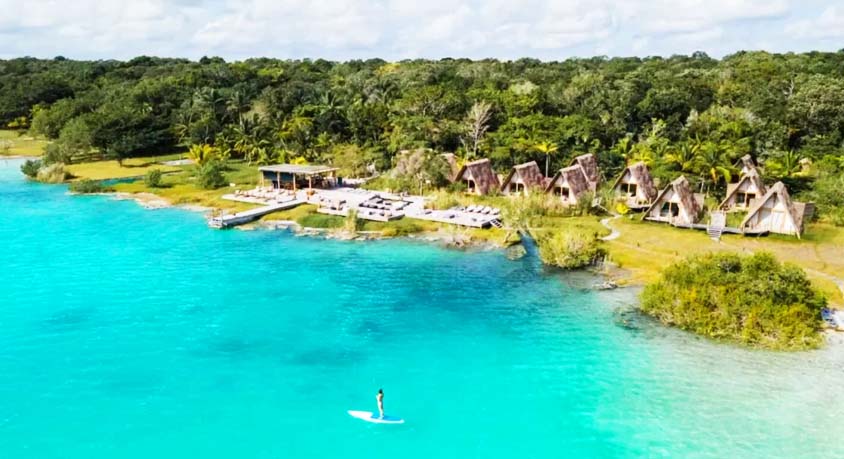
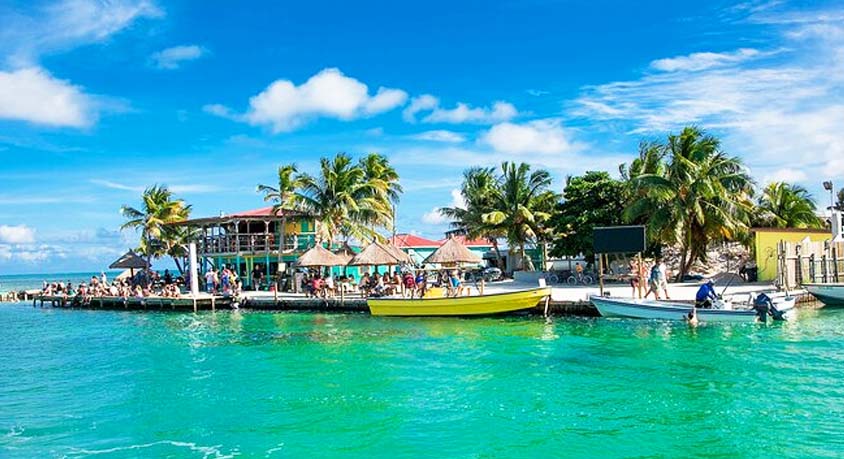
The sand squeezed between my toes was as fine as powdered sugar, and for a moment, the only sound was the rhythmic clack-clack-clack of a palm frond hitting a wooden sign that simply read "Go Slow." I was standing on the edge of "The Split," a narrow channel created by a hurricane decades ago, watching a local man expertly de-shell a conch with a rusty knife while the Caribbean sun turned the water into a sheet of liquid glass. There wasn't a single engine roar to break the spell—no taxis honking, no tour buses hissing. My brother tapped my shoulder and pointed toward the horizon where the reef began, and I realized that for the first time in years, I hadn't checked my watch once. Caye Caulker isn't just a location; it’s a deliberate refusal to participate in the twenty-first century's frantic pace, and that quietude is exactly what makes the sudden adrenaline of the water so jarring.
Tossing a tattered backpack into the back of a beat-up golf cart—the island’s version of a limousine—we headed toward a guesthouse that cost us $75 a night. For the Caribbean, that’s a rounding error, especially compared to the $400-a-night "luxury eco-huts" on the mainland that are basically just sheds with high-thread-count sheets and better marketing. We bypassed the flashy booking sites and found a spot with a creaky ceiling fan and a view of a hibiscus bush. In Caye Caulker, luxury isn't a marble bathroom; it’s the fact that you can walk from one end of the island to the other in twenty minutes without ever seeing a paved road. The "Go Slow" motto is enforced by the very terrain, as the sandy paths turn any attempt at a brisk walk into a sluggish trudge.
Sliding into the water at Shark Ray Alley, my heart did a frantic staccato against my ribs as a six-foot nurse shark brushed past my thigh like an oversized, sandpaper-skinned cat. Most travelers drop $600 for a scenic flight over the Great Blue Hole just to see a dark circle from a thousand feet up, but we spent $90 for a full-day snorkeling trip that put us face-to-face with the reef’s actual residents. The water was a swirling chaos of brown fins and silver scales. Our guide, a guy named Ras who seemed to be made entirely of salt and muscle, laughed at my hesitation. "They’re just looking for a snack, man, and you don't look like a sardine," he shouted over the wind. It’s a surreal financial trade-off: you can pay for the "iconic" aerial photo that everyone has on their Instagram, or you can pay a fraction of that to have a shark look you in the eye while you hover over the second-largest barrier reef on the planet.
Eating on the island is where the "tourist trap" vs. "local reality" divide becomes a comedy of errors. If you sit at a table with a white tablecloth and a printed menu, you’re going to pay $35 for a lobster tail that was likely caught by the same guy selling them on a stick for $10 at the beach. We spent our evenings at a roadside grill where the "menu" was whatever was caught that morning. For $12, I got a grilled lobster dripping in lime butter, a massive pile of coconut rice, and a plastic cup of rum punch that tasted like it could strip paint. My sister made the mistake of ordering a "standard American breakfast" at a cafe near the ferry dock and paid $18 for cold toast and eggs; the next day, we found a lady selling "Fry Jacks"—savory, deep-fried dough stuffed with beans and cheese—for $2. It was the best meal of the trip and cost less than a bottle of water in San Juan.
Navigating the transit from the US requires a bit of logistical gymnastics, usually involving a flight into Belize City followed by a choice: a $150 puddle-jumper flight to the island or a $35 water taxi. We took the boat, a forty-five-minute salt-sprayed ride that serves as a necessary transition from "American Stress" to "Island Chill." There are no hidden surcharges here, no "resort fees" tucked into the bill at the end of your stay. The only extra cost is the $10 reef fee that goes directly to conservation, a price I was happy to pay after seeing the vibrant purple sea fans and brain coral that looked like it belonged in a sci-fi movie. Everything is walkable, so the "transportation budget" was effectively zero, unless you count the $5 we spent to rent a rusted bicycle that squeaked with every revolution of the pedals.
We wandered away from the main strip to the northern part of the island, which is largely uninhabited and covered in dense mangroves. Here, we found a tiny, makeshift sanctuary for seahorses under a pier—a free "attraction" that offered more wonder than any overpriced aquarium. It’s the kind of place that reminds you why you travel: not to tick a box on a list of world wonders, but to find the quiet corners where the wild world still feels untouchable. During the late spring, the trade winds die down and the water becomes a mirror, though you have to be prepared for the occasional tropical downpour that turns the sand streets into a series of shallow lakes.
Caye Caulker challenges the idea that a Caribbean vacation has to be an expensive, curated performance of wealth. It’s a place where you can swim with predators in the morning and eat like a king for the price of a movie ticket in the afternoon, provided you don't mind a little sand in your shoes.