The sulfurous rot of rotten eggs wafted up through a jagged fissure in the asphalt, swirling around my ankles like a toxic ghost. I stood on a stretch of Route 61 that the earth had literally tried to swallow, watching a thin, persistent ribbon of white smoke curl out from a crack so deep it seemed to tap into the very center of the planet. There were no gift shops here, no ticket booths, and certainly no "Welcome to Centralia" signs—just a vast, eerie silence broken only by the rustle of overgrown weeds reclaiming what used to be a front yard. It was a moment of profound, unsettling stillness, standing atop a subterranean furnace that has been raging for over sixty years, turning a zip code into a legend.
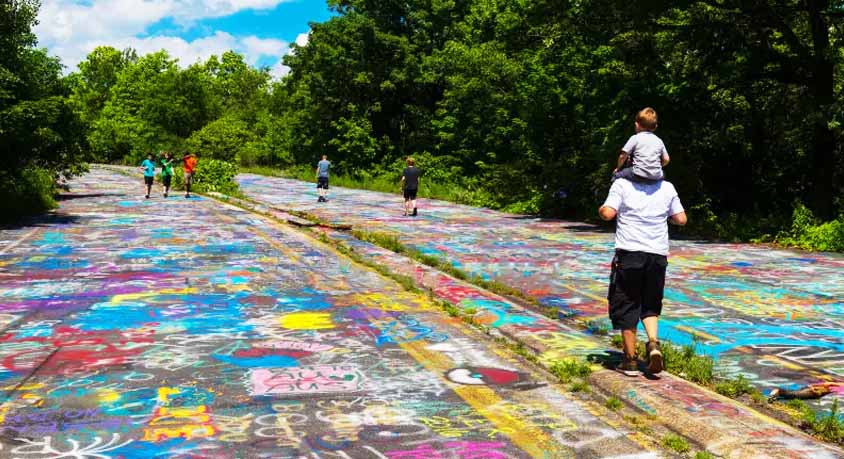
Stepping onto the buckled remains of the "Graffiti Highway"—though much of it was covered in mounds of dirt by the owners in 2020 to deter crowds—requires a certain level of comfort with the apocalyptic. Most people assume the entire town is a smoking crater, but the reality is much more subtle and haunting; it’s the grid of empty streets that leads to nowhere and the lone chimneys standing in fields of tall grass that get under your skin. I spent an hour tracing the old sidewalk lines, realizing that while the world calls this a "ghost town," the fire beneath is very much alive, invisible except for the vents where the ground temperature can spike to several hundred degrees. It is a free experience, provided you don't mind the risk of a sinkhole or the lingering scent of carbon monoxide that clings to your jacket for days.
Eating near a disaster zone means driving ten minutes out to the neighboring towns like Mount Carmel or Shamokin, where the prices reflect a blue-collar reality rather than a tourist markup. I walked into a local diner and ordered a "Pork Roll" sandwich and a coffee for under seven dollars, watching the locals ignore the "out-of-towners" who were busy wiping coal dust off their expensive camera lenses. If you’re looking for a curated culinary experience, you’ve taken a wrong turn at Harrisburg; here, the value is in the honesty of the grease and the fact that you aren't paying a "dark tourism" surcharge on your breakfast. I skipped the gas station snacks and stuck to the independent taverns where the beer is cheaper than bottled water and the conversation usually revolves around high school football or the declining price of anthracite.
Finding a place to sleep involves a similar strategy of retreating to the periphery, as no one in their right mind would build a Marriott on top of a slow-burning mine fire. I secured a room in a mid-range chain hotel in Bloomsburg for about $110, which felt like a bargain compared to the "historical charm" premiums you’d find in places like Gettysburg. The drive from the East Coast—about three hours from NYC or Philly—is a straight shot through the rolling Appalachians, but once you exit the highway, the GPS starts to get twitchy. There are no hidden resort fees in this part of Pennsylvania, just the occasional bridge toll and the realization that your car is going to need a thorough wash to get the grime off its undercarriage.
Exploring the St. Ignatius Cemetery, perched on a hill overlooking the burning valley, offered a chillingly quiet perspective on the town’s slow demise. I stood among the weathered headstones, looking down at the vents where the heat had killed the grass in perfect, brown circles, realizing that this is one of the few places where the dead are literally being toasted from below. It costs nothing to walk through these rows of names, but the cultural weight is immense—it’s a monument to a community that refused to leave until the government literally bought them out. Unlike the nearby Knoebels Amusement Resort, which draws thousands of families with its wooden coasters, this hill offers a different kind of thrill: the cold realization of human error and nature’s long memory.
Navigating the area between March and July provides a window where the smoke is most visible against the damp, spring air. I arrived in May, when the new green of the forest provided a jarring, beautiful contrast to the scorched earth and grey ash of the fire zones. The air can be heavy and humid, which traps the steam and sulfur near the ground, making the "smoking holes" look particularly dramatic for photos. You have to be wary of the "No Trespassing" signs that have multiplied recently; the local authorities aren't fond of people wandering into the restricted zones where the ground is most unstable. It’s not a "best time to visit" situation so much as a "best time to witness the decay" before the summer heat makes the subterranean steam invisible to the naked eye.
Centralia is a place that refuses to be a museum, a town that chose to burn rather than just fade away quietly. If you go, bring sturdy boots, a full tank of gas, and a healthy respect for the fact that the road beneath you is literally on fire.