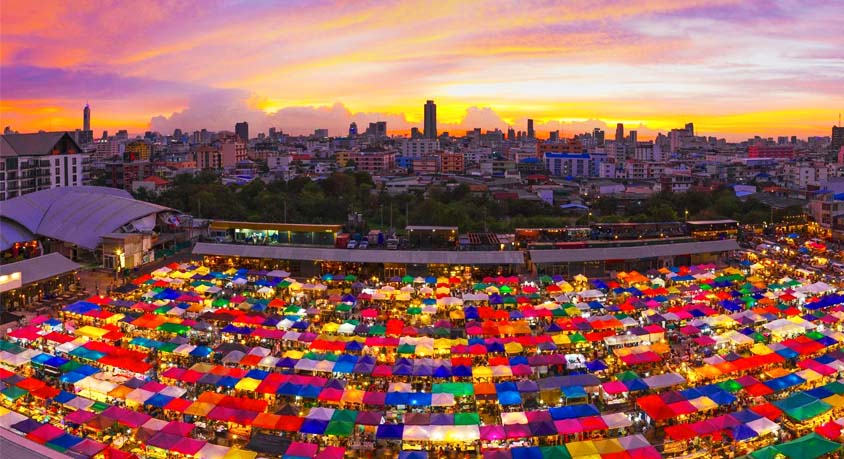
The taxi pulls off the main highway and into a parking lot so vast it could hold an entire suburban American town. Thousands of cars glitter under floodlights, and beyond them, a sea of colorful shipping containers, vintage neon signs, and the distant thump of live music drifts across the humid night air. This is Talat Rot Fai Srinakharin, the original Train Market, and it is absolutely nothing like the tourist markets you've been told to visit. The assumption, drilled into every first-time Bangkok visitor by guidebooks and hotel concierges, is that the city's night market experience begins and ends at Chatuchak or Asiatique—the former overwhelming, the latter overpriced. I arrived expecting another crowded maze of souvenir stalls selling the same elephant pants and wooden frogs. What I found, by venturing to the distant outskirts where locals actually shop, was a sprawling retro wonderland where vintage culture collides with Thai nightlife, and where your dollar buys things you can't find anywhere else.
The moment you step through the entrance arch, past a genuine 1950s American diner transported piece by piece and reassembled as a coffee shop, the financial logic of tourist Bangkok inverts completely. At Asiatique, a similar retro-themed area, a basic cocktail runs 250 baht, about $8, and a sit-down dinner for two easily hits 1500 baht. Here, at the market's central food court, a massive plate of grilled pork neck with sticky rice and spicy dipping sauce costs 80 baht, $2.50. A fresh coconut ice cream served in its shell, topped with peanuts and sticky rice, runs 40 baht, $1.20. Three people can eat and drink extravagantly for under $20, and the food is better—this is where Bangkok's east side comes to dine, not to be photographed. The market's sheer scale means competition among vendors is fierce, and prices reflect local reality, not tourist expectations.
For a proper meal, the indoor food hall at the market's center features dozens of stalls cooking everything from Isaan sausages to seafood pancakes, with most dishes falling between 50-100 baht. The local move is to order from multiple stalls, share everything, and wash it down with a bucket of ice and whiskey purchased from the market's many bars for 300 baht ($9)—enough to keep a group happy for hours.
For accommodation, the Srinakarin area is far from Bangkok's tourist centers, which is precisely the point. Hotels here cater to Thai business travelers and locals, with clean, modern rooms at the Hop Inn or similar chains running 800-1000 baht per night, $25-$30. The same money in a mid-sized American city might get you a budget motel with questionable sheets; here, it secures a spotless room with reliable WiFi and breakfast included.
Transportation to the market is the one area where you'll spend more than downtown, but the math still favors the adventurous. A taxi from central Bangkok takes 45 minutes in good traffic and costs 300-400 baht via meter, about $12. A ride-share like Grab runs similarly. Compare this to the 2000 baht ($60) that tour companies charge for "authentic night market experiences" that bus you to closer, more touristy alternatives, and the savings justify the journey. The hidden cost to avoid is the taxi driver who insists the market is closed or "too far" and offers to take you somewhere else instead. It's open Friday through Sunday from late afternoon until midnight, and any driver who claims otherwise wants a commission from another destination.
While the weekend crowds pack the central food area and the bar district, the real treasures of Talat Rot Fai hide in its sprawling vintage zones. The market is actually multiple markets in one, and the section furthest from the entrance, past the food and past the clothing, contains something you won't find anywhere else in Bangkok: a genuine retro village of repurposed shipping containers, each housing a vintage collector's personal obsession.
One container holds nothing but vintage Thai movie posters from the 1970s, their hand-painted artwork depicting impossible action scenes and romantic melodramas. Another contains restored jukeboxes, still playing 45s, with prices that would make an American collector weep with envy. The owners aren't merchants in the traditional sense; they're collectors who open their containers on weekends to share their passions and maybe sell to someone who understands. Prices are negotiable, but the real value is in conversation—learning why a Thai dentist spent twenty years collecting American license plates, or how a retired architect restored a 1962 Vespa using only period-correct parts.
Deeper into this zone lies the car district, where genuine vintage automobiles are parked in careful rows, their owners sitting on folding chairs nearby, happy to discuss every bolt and bearing. You'll see 1950s Chevrolet Bel Airs parked next to modified Thai tuk-tuks, 1960s Volkswagen vans beside Japanese mini-trucks from the same era, all maintained with a passion that transcends language. You can photograph them for free, sit in some with permission, and occasionally buy one if you have shipping arranged and $20,000 to spare. For a completely different vibe, the market's antique zone features stalls selling everything from century-old Thai ceramics to Art Deco furniture from Bangkok's golden age.
A small brass Buddha from the 1800s might cost 2000 baht ($60) after bargaining—less than a replica would cost at a tourist shop. A set of vintage Thai silk cushions from a wealthy family's estate sale runs 500 baht ($15). The key is to browse without urgency, return to stalls that interest you, and never accept the first price. Finally, don't miss the bar district's live music scene. Multiple stages feature Thai bands playing everything from American classic rock to traditional luk thung country music, and there's no cover charge. A 100 baht beer buys you a front-row seat to Bangkok's weekend soul.
Planning a visit between March and June requires reading Bangkok's seasonal clock with precision. March is the furnace month, with evening temperatures still hovering around 85°F and humidity that makes walking feel like wading. The market comes alive after sunset, typically around 5 p.m., and the heat actually works in your favor—Thais avoid the hottest hours, so early evening crowds are thinner. April brings Songkran, the Thai New Year water festival, when much of Bangkok empties as people return to their home provinces. The market operates on a reduced schedule, with fewer vendors but also almost no crowds. It's a gamble that can pay off with a uniquely intimate experience. May and June mark the rainy season's onset, with afternoon downpours that typically clear by evening, leaving washed-clean air and mercifully lower temperatures.
The market's covered areas make it viable even in light rain, and the dramatic skies behind the vintage neon signs create photography opportunities that sunny evenings can't match. Weekends are essential; the market barely functions on Fridays, with perhaps a third of vendors open, and is truly alive only on Saturday and Sunday. Your major cost is the flight into Suvarnabhumi Airport (BKK), which is actually closer to Talat Rot Fai than central Bangkok—about 20 minutes by taxi. This makes the market an ideal first or last stop on your Bangkok itinerary, saving transit time and taxi fares. Pack light, breathable clothing, comfortable walking shoes, and a bag with sturdy handles—you will buy things you didn't know you needed. Bring small bills in various denominations; many vintage vendors operate cash-only, and 1000 baht notes are difficult to break at smaller stalls. Insect repellent is non-negotiable in the vintage zones, where standing water and plants attract mosquitoes with relentless determination.