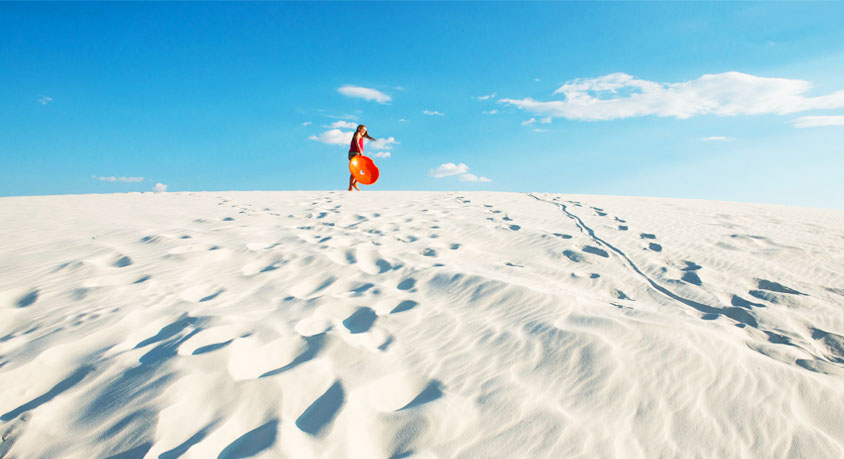
The glare hit me before I even stepped out of the car, a blinding, crystalline white that felt like a physical slap to the face. I squinted through my polarized lenses, watching a group of teenagers disappear over the crest of a massive drift, their laughter muffled by the strange, acoustic-absorbing quality of the gypsum. My thermometer read a dry 92°F, yet every instinct in my brain was screaming "snow." I kicked off my shoes, bracing for the searing burn of typical desert sand, but instead, my toes sank into a powdery surface that was shockingly, impossibly cool. It felt like walking on flour or pulverized pearls, a silent, undulating landscape that made me feel as if I had accidentally driven my rented SUV onto the surface of a frozen moon.
Sliding down a sixty-foot dune on a cheap plastic saucer is the kind of undignified joy that justifies a cross-country flight. I watched a father-son duo repeatedly fail to gain momentum until a local teenager leaned over and told them, "You gotta wax the bottom until it feels like ice, or the gypsum will just swallow you whole." Taking that advice, I spent five dollars on a block of wax at the gift shop, buffed the plastic until my arms ached, and launched myself into the abyss. The sensation isn't quite like sledding on snow; it’s more controlled, a velvet-smooth glide that leaves you at the bottom with sand in places you didn't know you had, wondering why anyone would ever pay $150 for a lift ticket at a ski resort when you can have this for the price of a burger.
Eating near the park is a strategic exercise in avoiding the "convenience trap" of the solitary visitor center. I checked the prices of the pre-packaged wraps at the entrance—fourteen dollars for something that looked like it was made in the previous decade—and decided to backtrack twenty minutes to Alamogordo. There, I found a hole-in-the-wall joint where a massive plate of green chili enchiladas set me back exactly ten dollars. The local-to-tourist price gap here isn't enforced by a menu; it’s enforced by effort. If you’re willing to drive ten miles away from the "scenic" signage, the cost of a meal drops by half and the flavor profile shifts from "bland tourist fuel" to authentic New Mexican fire.
Securing a place to sleep without paying the "scenic view" premium requires looking toward the mid-range motels that line the highway rather than the boutique lodges that market themselves to Instagram influencers. I stayed in a clean, no-frills motel for $85 a night, a fraction of what the "eco-domes" nearby were charging for a canvas tent and the "privilege" of sleeping on a platform. Since there are no hotels inside the park itself, everyone has to commute, so paying three times the price for a room that is five miles closer to the gate is a financial blunder I see travelers make constantly. The lack of hidden resort fees or mandatory valet charges in the standard motels meant I had enough left over to splurge on a high-quality tripod for the sunset session.
Capturing the "perfect" shot at White Sands is less about having a $5,000 camera and more about understanding the geometry of shadows. I waited until the "Golden Hour," that forty-minute window before the sun dips behind the San Andres Mountains, when the white dunes stop looking like flour and start reflecting shades of lavender, rose, and deep gold. I saw a couple trying to take portraits at high noon, their faces washed out by the harsh, vertical light and their eyes squeezed shut against the glare; they looked miserable. I walked about a mile into the Alkali Flat Trail—far enough that the footprints of other tourists disappeared—and set up my shot as the shadows elongated into long, dramatic fingers across the ridges. This deep-field experience is free, but it requires the patience to wait out the heat and the willingness to walk past the first three dunes where everyone else huddles.
Visiting between March and June is a high-stakes gamble with the New Mexico wind. I flew into El Paso from the East Coast—a total travel time of about seven hours including layovers—and drove the ninety minutes north just as the spring "dust season" was peaking. One afternoon, the wind kicked up so fiercely that the entire park turned into a white-out, forcing me to retreat to my car as the gypsum sand blasted the paint job. However, the reward for braving the spring is the blooming yuccas, whose tall, creamy flower stalks pierce the white horizon in a way you won't see in the dead of winter. The crowds are thinner in these shoulder months, and the entrance fee remains a flat $25 per vehicle, which feels like a steal for access to 275 square miles of surrealism.
White Sands isn't a place for the lazy traveler or the person who needs a paved path to feel safe; it’s a shifting, blindingly bright wilderness that rewards those who bring their own shade and a block of sled wax. If you can handle the glare and the grit, you’ll find a landscape that makes every other desert on earth look dull by comparison.