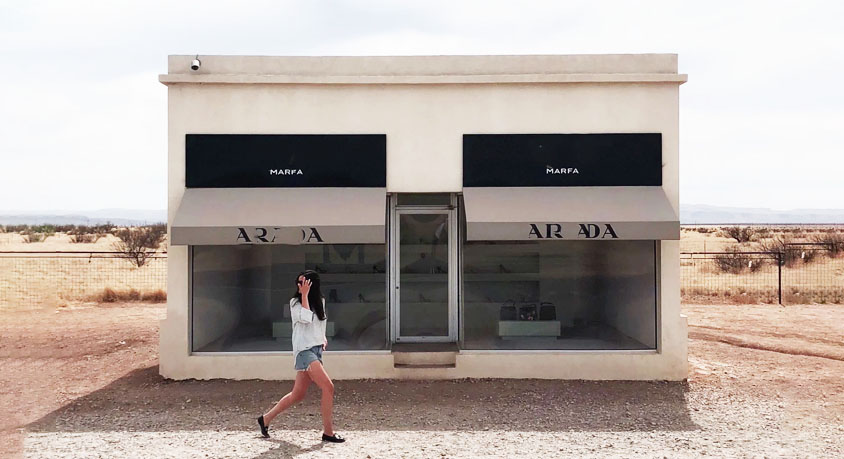
The dry heat of the Chihuahuan Desert was already vibrating off the asphalt when I spotted the logo—a stark, monochrome silhouette of high fashion rising out of the scrub brush like a glitch in the simulation. I pulled my dusty SUV to the shoulder, the gravel crunching under my tires with a satisfying finality, and stared at the pristine window displays of Prada Marfa. Behind the glass, autumn/winter 2005 bags and shoes sat perfectly undisturbed, slowly being reclaimed by the desert sun while a tumbleweed rolled lazily across the doorstep. There were no sales clerks, no scent of expensive perfume, and absolutely no way to get inside; it was just me, a silent monument to luxury, and a horizon that stretched toward infinity.
Navigating the seven-hour haul from Austin or the three-hour trek from El Paso is a rite of passage that humbles your bank account before you even see a single art installation. I watched the fuel gauge drop with a sense of impending doom, knowing that the "tourist price" for gas in these remote stretches is essentially whatever the solitary station owner decides it should be that day. To keep my costs from spiraling, I packed a cooler with local pecans and topo chico, bypassing the $15 artisan beef jerky sold at the roadside stops that cater to pilgrims of the "minimalist" lifestyle. Marfa is a place where you can easily spend $40 on a "rustic" grilled cheese if you aren't careful, so I made it a point to hunt for the unassuming food trucks tucked behind the main drag where the locals actually eat.
Finding a place to sleep in a town of 1,700 people that doubles as a global art Mecca is a lesson in financial irony. I avoided the boutique hotels where a spartan concrete room costs $400 a night—a price they justify as "curated emptiness"—and opted instead for a vintage trailer at a local glamping site for a more manageable $150. It still felt like a lot to pay for a tin can in the desert, but the trade-off was a unobstructed view of the stars and a lack of the "historic preservation fees" that the downtown inns love to tack onto your bill. The town is small enough to walk across in twenty minutes, so I parked the car and leaned into the dust, saving on the hidden costs of driving back and forth to the outskirts.
Standing in the middle of Donald Judd’s massive aluminum boxes at the Chinati Foundation, the silence was so heavy it felt physical, a far cry from the crowded galleries of Manhattan. While most visitors flock to the Prada store for the photo op, I found that the real weight of Marfa lies in these permanent installations that cost next to nothing to view from the perimeter if you skip the $50 guided tour. I spent hours watching the light shift across the metal surfaces, reflecting the harsh desert landscape in a way that felt both futuristic and ancient. It is a stark contrast to the misconception that Marfa is just a playground for influencers; there is a lonely, profound intentionality here that requires you to slow down your heart rate just to process it.
Watching the horizon at the Marfa Lights Viewing Center as dusk turned to an inky purple, I overheard a couple arguing about whether the flickering orbs were atmospheric reflections or something more supernatural. I sat on the concrete bleachers, which are free to access, and waited for the "mystery" to reveal itself. Whether they are ranch lights or phantom spirits, the experience cost me nothing but time, providing a cultural ghost story that carries more weight than any souvenir shop trinket. It is one of the few places where you can engage with a local legend without a ticket booth standing in your way, a rare find in a town that has become increasingly commodified by the jet-set art crowd.
Visiting between March and June is a strategic gamble with the elements, as the desert is currently transitioning from a bitter winter chill to a searing summer furnace. I arrived from the East Coast, a journey that involved two flights and a grueling drive, only to find that the "spring" weather meant 40-degree swings between noon and midnight. The wind in May can be relentless, sandblasting your face as you walk between galleries, so a heavy denim jacket and a scarf aren't fashion statements—they’re survival gear. Prices for everything from espresso to vintage t-shirts tend to spike during the spring break weeks, so I timed my arrival for a Tuesday in April, catching the town in a rare moment of genuine, unhurried stillness.
Marfa is a town built on the absurd reality that humans decided to plant a flag of high culture in a place that clearly wants to be left alone. If you can handle the dust, the distance, and the high price of a quiet cup of coffee, you'll find a version of Texas that feels like a dream you haven't quite woken up from yet.