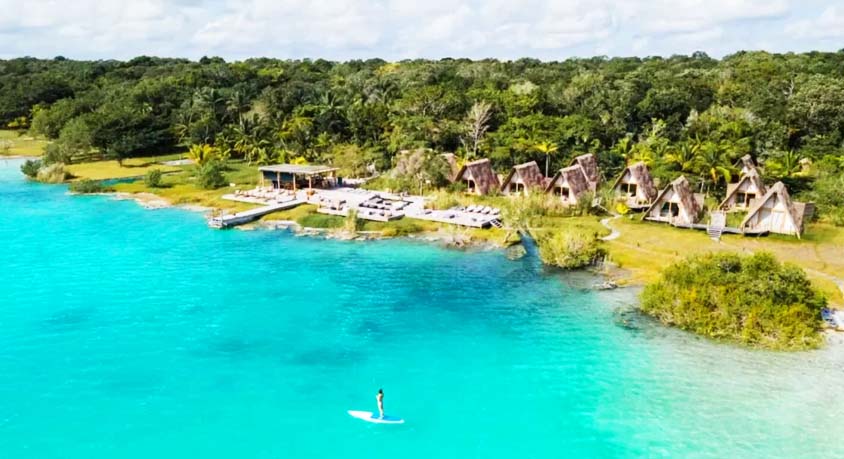
The water didn't just ripple; it seemed to vibrate in shades of turquoise so aggressive I thought my sunglasses were malfunctioning. I was sitting on a weathered wooden pier in Bacalar, dangling my feet into a freshwater lagoon that felt like silk against my skin, watching a tiny white snail crawl across a prehistoric-looking rock called a stromatolite. There wasn't a single jet ski screaming in the distance, and the only "club music" was the rustle of mangrove leaves and the distant chatter of a local fisherman. This wasn't the Mexico you see on a Spring Break flyer—the one with the stinking piles of brown seaweed and the thirty-dollar margaritas—it was something much older and infinitely more fragile.
Tulum has become a parody of itself, a place where you pay fifty dollars for "spiritual" avocado toast while sitting in a traffic jam of rental Jeeps, but just four hours south, the financial reality does a complete 180-degree flip. We drove down from Cancun, a journey that takes about four and a half hours of dodging speed bumps (topes) on Highway 307, skipping the overpriced private shuttles that quote you $300 for the ride. Instead, we grabbed an ADO bus for roughly $30, which offered air conditioning so cold I had to put on a hoodie in the middle of the tropics. When we arrived, the lack of high-rise hotels was jarring; instead of concrete giants, Bacalar is a patchwork of low-slung cabanas and hidden garden gates that don't feel the need to shout for your attention.
The "Lake of Seven Colors" is a biological miracle that most people treat as a mere backdrop for photos, but the cost of actually experiencing it is surprisingly low if you avoid the "VIP" pontoon tours. We walked down to a public access point (balneario) where the entry fee was about $2, compared to the $80 private boat charters being pushed at the town square. I watched a group of tourists from a luxury hotel pay a guide ten times what we spent just to reach the Canal de los Piratas, a shallow stretch of white sand and electric-blue water where the pirates of the 17th century actually traded goods. We simply paddled there in a rented kayak for $10 an hour, steering ourselves through the crystal-clear channels without a captain breathing down our necks to stay on schedule.
Eating in Bacalar felt like I was finally being apologized to for the prices I paid in the Riviera Maya. At a small, family-run spot called a cocinería, I tucked into a plate of "Cochinita Pibil"—slow-roasted pork marinated in achiote—that cost me exactly $6, including a fresh hibiscus water. Meanwhile, back in Tulum, the same meal would have been rebranded as "Artesanal Slow-Cooked Heritage Pork" and served on a stone slab for $28. The local-versus-tourist price gap here isn't a trap; it’s a reward for being willing to walk two blocks away from the main fort. My friend ordered a round of local beers at a lakeside bar, and when the bill came out to $12 for four people, he genuinely thought they had forgotten to charge us for two of them.
We stayed in a mid-range lagoon-front guesthouse for $90 a night, which featured a private dock and a hammock that swung over the water. In the more "famous" parts of the Yucatan, that same $90 might get you a windowless room near a loud construction site. Transportation within the town is almost entirely unnecessary because the central area is so compact, though we did flag down a local taxi once to get to the Cenote Azul—a deep, sapphire-blue sinkhole that looks like a giant eye in the jungle. The fare was $3, flat. No "gringo tax," no haggling, just a polite "gracias" and a tip that the driver actually appreciated rather than expected as a birthright.
For those looking for something truly off the radar, the Los Rapidos channel is a must-visit where the lagoon narrows and a gentle current creates a natural "lazy river." While it’s becoming more popular, if you go on a Tuesday morning like we did, you’ll have the prehistoric stromatolites (essentially living rocks) all to yourself for a $10 entry fee. Another overlooked gem is the Fort of San Felipe; most people just take a photo of the exterior, but for $5 you can walk the ramparts where the locals fought off actual pirates, offering a panoramic view of the seven colors that no drone shot can replicate.
Visiting during the late fall means dodging the peak summer heat and the winter "snowbird" crowds, though you should expect a quick afternoon rain that clears the air. The water temperature stays like a warm bath, and the prices for boat rentals are much more flexible when the owners aren't looking at a line of twenty people behind you.